Every winter the same thing happens. You zip up a full-length puffer, catch your reflection in a shop window, and look like a duvet with legs.
The coat is usually not the problem. The way it is worn is. Long puffers fail on proportion rather than style, and four adjustments fix almost every case.
Stop treating the coat as the outfit
A long puffer covers most of your body. That makes it background, not foreground — and it needs something deliberate underneath. Most people do the opposite: a heavy knit under a heavy coat, a chunky scarf on top, then confusion about why the silhouette reads wide from every angle.
Treat the puffer as the outer shell of a slim outfit. Whatever sits underneath should be the thinnest thing that keeps you warm: a fine merino crew, a thin cashmere knit, a fitted turtleneck. If you need more heat, add a mid-layer with structure — a quilted liner, a slim wool vest — instead of more loft.
Rule one: define the waist, even a little
This is the highest-return change you can make. An unbroken column of nylon from shoulders to calf gives the eye no reference point, so it reads as one flat mass. Break that line at your natural waist — not the jacket’s belt loops, the narrowest point of your own torso — and the coat becomes a shape instead of a bag.
Three ways to do it, in order of how well they work.
Buy a coat that already does it. Moncler’s long women’s styles are cut this way. The slim long down jacket with a hooded collar runs tight boudin quilting — those narrow horizontal tubes — through a tailored silhouette so the down sits close instead of ballooning. Moncler’s own copy for its Moka long down jacket states the intent plainly: a streamlined, slim silhouette and tight boudin quilting that hug the body, providing warmth without adding bulk or volume. That is the whole brief in one sentence.
Next best: a self-tie belt cinched at the natural waist on a coat that is already fairly close-fitting. Cinch it on a coat that is genuinely oversized and you get squeezed-down filling bulging above and below the strap, which is worse than no belt at all. Check in a mirror from the side, not the front.
Last resort: your own thin leather belt worn over the coat. Works on slim and straight-cut puffers, fails on anything with real volume. If your coat is a full-loft parka, leave the belt in the drawer and work the proportions instead.
Rule two: keep the bottom half slim
Volume needs contrast. A long puffer over wide-leg trousers or a full midi skirt is the fastest route to looking like you got lost inside your own clothes, and no amount of accessorising rescues it.
What works: straight-leg or slim denim, tailored wool trousers, leggings, a fine knit dress, a pencil skirt with opaque tights. Anything with a clean vertical line. The coat is the wide element, so everything else is the narrow one.
One detail worth knowing before you buy. A quilt-through parka with fine, dense channels reads far slimmer than a coat with fat, widely spaced baffles, because quilting direction changes how the eye travels. Vertical channels stretch the line downward; horizontal ones cut across the body and make the same silhouette read wider. It is the old Helmholtz illusion doing its work on fabric — the same reason vertical stripes read taller on a shirt. Given two long puffers of similar warmth, take the one with the finer, more vertical quilting.
Rule three: pick the length for your height, not the trend
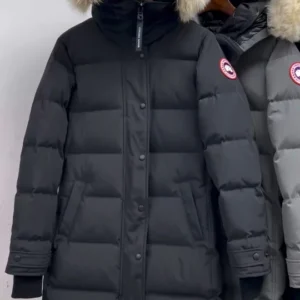
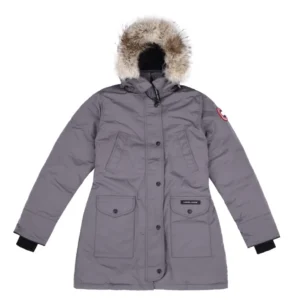
Long puffers come in three practical lengths and they do not flatter everyone equally. The Canada Goose long puffer range is a useful place to see all three side by side.
Mid-thigh to knee
The most versatile zone and the safest. It covers what gets cold first without swamping the frame. If you are under about 5’4″, start here.
Calf
This is where the Canada Goose Mystique Parka sits. The Mystique exists because an actress working in the cold asked for a full-length parka that would also look right on a night out. The answer was a calf-length coat with a quilt-through construction that spreads the down evenly instead of stacking it into thick lumps — its own design notes describe a finish that distributes warmth without adding bulk. It carries Canada Goose’s TEI 5 rating, good to -30°C and below, on 625 fill power white down under an Arctic Tech shell, and it still reads as a long clean column rather than a sleeping bag. Tall frames carry calf length beautifully. Petite frames usually do not, unless the coat is cut narrow and everything underneath is monochrome.
Ankle
Dramatic, warm and unforgiving. Unless you are tall and wearing a heeled boot, ankle length erases your legs entirely, and it restricts your stride — which is why well-made ankle-length puffers use a two-way zip and side vents.
Whatever length you land on, do the mobility test before you commit: walk up stairs, sit down, reach overhead. A coat you have to fight stays on the hook.
Fabric and finish change the whole read
Glossy shells amplify volume. Light bounces off every curve, so the coat looks rounder than it is. Matte finishes flatten the silhouette and generally look more expensive. That is why a Prada Re-Nylon long down jacket with a hood looks leaner than its measurements suggest: Re-Nylon is a regenerated nylon made from recycled fishing nets, carpet offcuts and textile waste, and its surface is dry and matte rather than lacquered. It reads technical and urban, which pairs far better with tailored trousers than a shiny shell does.
If your puffer is high-gloss, lean harder on everything else: matte wool below, leather boots, no shiny accessories. Do not compete with the coat.
Footwear and the top third
Flimsy shoes vanish under a long hem and make the whole look bottomless. Ground it on purpose — leather ankle boots, knee-high boots, or a substantial sole. Chunky boots keep it casual; a heeled or sleek leather boot moves it toward the city.
At the other end, keep the neck thin. A fat oversized scarf adds back the volume you just spent three sections removing. Use a fine merino or cashmere scarf tucked into the collar, or a slim beanie that sits close to the skull. A crossbody bag worn over the coat is a quiet win too: the diagonal strap slices through the volume and gives the eye somewhere to land.
FAQ
Does belting a puffer jacket actually improve the look?
Up to a point. On a slim or moderately fitted coat, a belt defines the waist and works. On a genuinely oversized, high-loft coat it makes things worse, because the strap squeezes down into a bulge above and below. Judge it from the side.
Should a long puffer fit tight or loose?
Close through the shoulders and body, with just enough room for a thin knit underneath. A coat that gaps at the armhole or the hem lets cold air circulate, which defeats the point. Oversized is a silhouette decision, not a warmth strategy.
Can I wear a long puffer over a dress?
Yes, and it is one of the easier looks to get right. A fitted knit or sweater dress holds a clean line under the coat, and you can shed the puffer indoors to reveal a full outfit. Full-skirted, floaty dresses are the ones to leave at home.
How do I stop a long puffer looking cheap?
Three things do most of the work: matte over gloss, fine quilting over fat baffles, and neat hardware. Then keep the rest of the outfit quiet — one colour underneath, structured footwear, no competing logos.
Bottom line
Long puffers look bulky because they get worn like a costume instead of a layer. Define the waist, keep everything underneath slim, choose a length your height can carry, then ground it with real footwear. That is the whole method, and it takes about two minutes in front of a mirror.
If you want to compare how different lengths and finishes look next to each other, the Moncler long puffer jackets collection is a good place to start — the differences in cut and quilting are obvious once you know what you are looking at, and the same rules apply across every brand on the site.