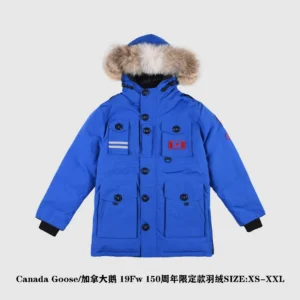
Two puffers hang side by side on the same rail. One tag says 800 fill. The other says 700. Most people take the 800 and never read the second number on either tag, which is the one that actually decides whether they spend the winter warm or cold.
Fill power and fill weight measure two completely different things. Once you know what each one does, and how they work together, buying a down jacket stops being a guessing game.
Fill power measures quality, not quantity
Fill power is a lab number. A fixed weight of down is conditioned, poured into a cylinder, and a weighted disc is lowered onto it. Where the disc settles tells you how much volume that down can fill. Big, mature clusters push the disc up high. Small, broken or dusty clusters barely move it.
The IDFB method — the international standard most brands test to — uses a 30 g sample, loosens it, compresses it under a disc and reads the height after 60 seconds. That height is converted into cubic inches. This is where “700 fill” and “800 fill” come from: 700 fill means one unit of that down lofts into 700 cubic inches of space.
Read that again, because it matters: fill power is the volume a fixed weight of down occupies. It says nothing about how much down is in the jacket. It is a grade, not a quantity.
Why the same down can carry two different numbers
For decades the American figure was quoted per ounce (28.35 g) while the European EN 12130 test used a different conditioning routine, so the same lot of down could test noticeably higher on one side of the Atlantic than the other. EN 12130 was revised in 2018 to use a 30 g sample and steam conditioning, which brought the two methods much closer together. The IDFB now reports officially in cubic inches per 30 g, but plenty of brands still print the older per-ounce figure.
Moncler, for example, states that its down carries a minimum fill power of 710 cubic inches per 30 grams. Convert that to the ounce-based figure and it lands around 670. Neither number is wrong. They are the same down described in two currencies, which is exactly why comparing two tags from two brands needs a moment’s care.
Fill weight is the number brands leave off
Fill weight is simply how much down is inside the jacket, in grams or ounces. It is the quantity half of the equation, and it is the half you usually have to dig for — sometimes emailing a brand to get it, because it does not sell as well as a big fill power headline.
Run the arithmetic and the trap is obvious. Three ounces of 800-fill down is 2,400 cubic inches of trapped air. Four ounces of 700-fill down is 2,800. The 700 jacket wins, despite the worse number on the tag, because there is more down in it.
A rough way to compare two jackets
Multiply fill power by fill weight. That product is not a temperature rating and it ignores construction, but it is a far better guide than either figure alone. A jacket carrying 120 g of 700-fill down holds more insulation than one carrying 90 g of 800-fill. And if a brand quotes fill power while staying quiet about fill weight, treat the warmth claim as marketing until you find the spec sheet.
What these numbers look like on real jackets
Canada Goose is one of the few big names that publishes both, and it is instructive. Its parkas use down rated somewhere between roughly 625 and 800 fill power, and the brand leans on its own Thermal Experience Index — a 1-to-5 scale where TEI 5 means -30°C and below — rather than fill numbers on their own. The Snow Mantra, the warmest jacket it makes, is built on 675-fill white goose down in a double layer of baffles. A Canada Goose Expedition Parka carries the same TEI 5 rating. The reason both of them work is not the fill power — 675 is unremarkable on paper — it is the amount of down packed in and the construction holding it in place.
The North Face takes the opposite approach. The North Face 1996 Retro Nuptse wears its 700-fill rating in the name and is honest about what it is: RDS-certified goose down, oversized baffles, and a jacket weighing under a kilo because the fill weight is modest. A superb city layer. A poor stand-in for a parka.
Moncler barely mentions fill numbers at all. Its published standard is at least 90% white goose down cluster to no more than 10% feather, with that 710-per-30g minimum. A Moncler Vezere short puffer shows what you are paying for in that trade: a light, glossy shell, a high down-to-feather ratio, and a cut that sits neatly over a suit. It is warm. It is not the warmest thing on the rail.
The third number: how the down is held
Fill power and fill weight both describe loose down in a bag. What decides how much of that down you actually feel is the construction between shell and lining — and it never appears on a tag.
Sewn-through vs box-wall baffles
Sewn-through construction stitches the shell straight to the lining. It is light, cheap and quick to make, and at every stitch line the down is compressed to nothing, so you get a grid of thin, slightly colder stripes. Box-wall construction sews a third strip of fabric between the two layers, creating real three-dimensional chambers where the down lofts fully with no squashed seams. It is warmer for the same fill weight, heavier, and more expensive to build. That is why the flagship models in the Canada Goose parka lineup use it, while most lightweight city puffers do not.
Why no jacket has a real temperature rating
Sleeping bags are tested to a formal standard that produces a comfort temperature. Jackets are not — there is no equivalent test. Every “rated to -30°C” claim is therefore either a brand’s own scale, like Canada Goose’s TEI, or a marketing decision. Real-world warmth also depends on what you wear underneath, whether you are walking or sitting still, and how much wind is moving around you. Use the published numbers to compare jackets with each other. Do not read them as a weather forecast.
FAQ
Is 800 fill warmer than 700 fill?
Not automatically. 800 fill is better down — it lofts more per gram, so it is lighter and packs smaller for the same warmth. But absolute warmth is fill power multiplied by fill weight. A 700-fill jacket with more down inside beats a thin 800-fill one every time.
Which brands actually publish fill weight?
Outdoor and technical brands usually do, because their customers weigh their gear. Luxury labels often do not. Canada Goose publishes fill power and its TEI rating; Moncler publishes its down-to-feather ratio and a minimum fill power. If the number is missing, ask for it — it is a spec sheet item, not a trade secret.
Should I always pay more for higher fill power?
Only if you need what it buys. Higher fill power comes from larger, more mature bird clusters that make up a smaller share of each harvest, so it genuinely costs more to source. What you get back is warmth per gram and packability. If the jacket lives on a coat hook rather than in a backpack, put the money into fill weight and baffle construction instead.
What is a good down-to-feather ratio?
90/10 is the good standard; cheaper jackets often run 80/20. Feathers have no loft and add weight, so a higher down percentage means more insulation per gram and less chance of quills working their way through the shell.
Bottom line
Two numbers, one rule. Fill power tells you the grade of down you are getting; fill weight tells you how much of it is in there. Multiply them before you decide anything. Then look at the construction, because a well-baffled 650-fill parka will keep you warmer than a thin 800-fill jacket on any genuinely cold day.
If you want to see the whole range next to each other, the puffer jacket collection runs from lightweight 700-fill city puffers up to the double-layer parkas built for real winters.