Wash a replica Canada Goose puffer jacket on a gentle cold cycle with a down-specific detergent, tumble dry on low with dryer balls until every clump is gone, and store it uncompressed for the off-season. That routine is the whole of replica Canada Goose puffer jacket care, and it keeps a down vest lofted for years. Skip them, and the fill mats, the collar flattens, and the vest stops looking premium no matter how good the stitching was. This guide walks through each step for a down vest specifically, because vests have less fill than parkas and show neglect faster.

Why Replica Canada Goose Puffer Jacket Care Is Different From a Regular Jacket
Down is not fabric. It is clusters of filaments that trap air, and trapped air is what keeps you warm and makes the vest look full. Every wash, squeeze and fold that pushes air out of those clusters is a small injury. A regular cotton jacket survives a hot wash and a wring-out; a down vest loses loft and dries in clumps.
Two things make down care non-negotiable on a vest like ours:
- Baffles are sewn channels. The stitched lines that make a vest look quilted are also barriers. If fill clumps inside one channel, nothing redistributes it on its own. You have to break the clumps up manually with heat and tumbling.
- Shells on quality replicas are treated. Most down vests use a densely woven shell that resists light drizzle. Harsh detergent strips that finish, so the vest wets out faster the next time you wear it in snow.
The upside: down care is simple once you understand it. Cold water, mild down soap, patience in the dryer. Nothing about it needs special equipment.
Washing a Down Vest: Temperature, Detergent and Machine Settings
Hand washing always wins for down. Fill a tub with lukewarm water, add a capful of down wash, submerge the vest, and work the soapy water through the panels with your hands for a few minutes. Press water out gently. Never wring or twist a down vest, because twisting tears down clusters apart and starts permanent clumping.
If you use a machine, front-loaders are far safer than top-loaders with center agitators, which grab baffles and yank them. Settings that work:
| Setting | Use this | Why it matters |
|---|---|---|
| Water temp | Cold or 30°C max | Hot water stresses shell coatings and can shrink baffles |
| Cycle | Delicate or down cycle | Slow agitation prevents fill migration into sewn channels |
| Detergent | Down-specific wash only | Regular detergent leaves residue that mats down clusters |
| Spin | Lowest speed | High spin packs fill against baffles hard and starts clumps |
| Fabric softener | Never | Coats down filaments and kills their springiness |
Rinse twice. Detergent residue is the number-one cause of flat, sticky-feeling down, so an extra rinse cycle is cheap insurance. If you want the full washing walkthrough with product suggestions, our guide on how to wash a Canada Goose down vest covers detergents and stain spot-treatment in detail.
Drying and Re-Lofting Without Killing the Fill
Drying is where most vests die. Out of the washer a down vest looks terrible: flat, heavy, with the fill balled into wet lumps. That is normal. It only looks broken.
Tumble dry on low heat, and plan for two to three hours. Down holds water stubbornly, and rushing with high heat melts shell coatings and sinters fill together permanently. Toss two or three wool dryer balls, or clean tennis balls, into the machine. Every 30 minutes, pull the vest out, break up clumps with your fingers, shake it hard to redistribute fill, and put it back.
You are done when the fill feels like loose powder through every panel and there is no cold spot anywhere. Press a baffle between your fingers: it should spring back instantly. Any area that stays flat means a clump is still wet inside, so keep drying. Air drying flat is a backup, not a choice, because without tumbling the clusters settle and dry in their clumped shape.
Off-Season Storage That Keeps the Loft
Compression is the enemy. Vacuum bags and tight closet squeezing flatten down for good if they hold for months, because clusters lose their memory and never fully spring back.
Store the vest clean and fully dry in a breathable cotton garment bag, hung on a wide hanger, or folded loosely in a large pillowcase on a shelf. It needs air circulation more than it needs space. Two rules cover the whole job:
- Never store it dirty. Body oil left in the shell oxidizes over summer and leaves yellow marks that are close to impossible to wash out in fall.
- Never store it wet. Even slightly damp down grows mildew in a closed closet, and mildew smell never leaves.
Quick Fixes for Common Problems
Most care complaints have simple causes, and most are fixable if you act early:
- Fill clumps in one or two baffles. Re-run a full low-heat dryer cycle with dryer balls and break the clump by hand each interval. If the vest is dry already, flick and massage the clump until the cluster separates, then give it a short dryer warm-up.
- Collar and shoulder look flat. That is compression from hanging the vest by its collar or resting on it in a closet. Dryer time plus a day hung free usually restores it.
- Feathers poking through the shell. Normal on any down garment. Pull the feather from the inside, do not yank it out, and rub the tiny hole closed between your fingers. Do not sew it shut tightly or you create a bigger leak.
- Yellowing near the collar. Caused by sweat and stored dirt. Spot-wash with down soap and lukewarm water before the full wash.
- Lost water repellency. A spray-on DWR treatment restores beading water. Apply to a clean, dry vest and let it cure fully before wearing.
What Not to Do
Short list, all common mistakes: no dry cleaning, because solvents strip the natural oils inside down and leave it brittle. No fabric softener or regular detergent. No wringing, twisting or hanging-dry-over-a-radiator, which cooks the fill against the heat source. No vacuum sealing for storage. And no ironing, ever, on a down vest shell.
Where to Buy a Replacement
Care only goes so far, and the honest limit of replica Canada Goose puffer jacket care is this: once baffles stay flat after a full re-loft cycle, replacement is the answer. Our Canada Goose down vests collection carries boxy, glossy and matte black styles in the $130–$150 range that respond well to the care routine above. Browse the full Canada Goose range if you want parkas alongside vests.
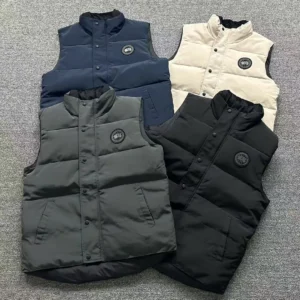 Canada Goose Black Boxy Down Vest$135View product
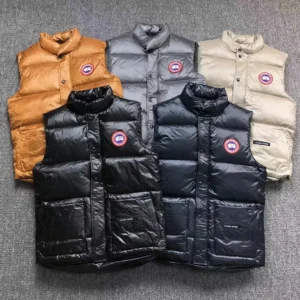 Canada Goose Black Glossy Down Vest E$135View product
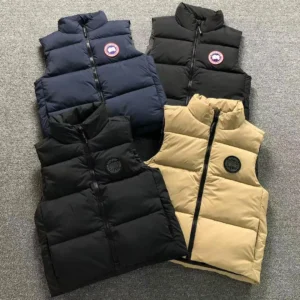 Canada Goose Black Label puffer vest$135View product
Boxy black down vests that respond well to proper washing and re-lofting
Fit matters as much as care when a vest looks right, so if you are between sizes, our Canada Goose fit guide with real S to XXL measurements removes the guesswork. For the full-length version of the same fill technology, see our review of the replica Canada Goose Langford parka and what its cut and warmth feel like in daily wear.
FAQ
How often should I wash a down vest?
Only when it is dirty or smells. Down does not need scheduled washing, and every wash costs some loft. Two to three times per winter, with spot-cleaning in between, is plenty for daily wear.
Can I machine wash a down vest in a top-loading washer?
Yes, if the machine has no center agitator. An agitator grabs baffles and tears stitching. If your only machine has one, hand wash in the tub instead. Front-loaders are the safest bet.
What detergent should I use?
A down-specific wash like Nikwax Down Wash or Grangers Down Wash. Regular detergent and softener leave residue that mats the fill and reduces warmth. Two rinse cycles clear whatever the first rinse misses.
Why is my down vest lumpy after washing?
The fill is still wet inside the clumps. It is not ruined. Tumble dry on low with dryer balls, breaking up clumps every 30 minutes, until every baffle springs back. Total drying time often runs two to three hours.
Can I put a down vest in the dryer?
Yes, and you should, on low heat only with dryer balls. The tumbling is what re-lofts the fill. What kills down is high heat, so keep the setting low and be patient.
How do I store a down vest in summer?
Clean, completely dry, loosely folded in a breathable bag on a shelf, or hung on a wide hanger. Never vacuum-sealed and never in a plastic bin squeezed tight, because months of compression flatten down permanently.
Can I dry clean a down vest?
No. Dry-cleaning solvents strip the natural oils in down, which makes clusters brittle and shortens the vest’s life. Home washing with down soap is both safer and cheaper.