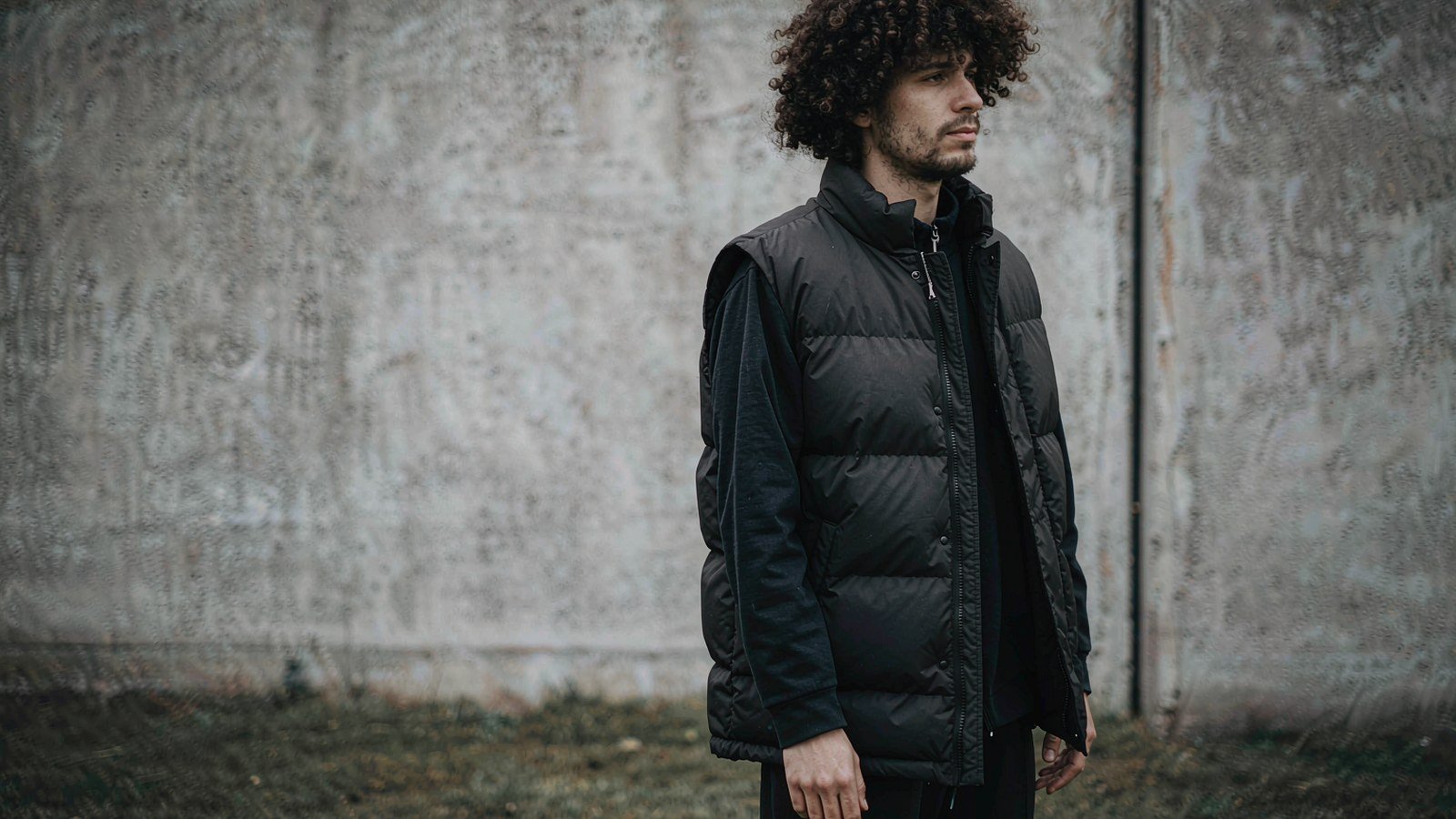
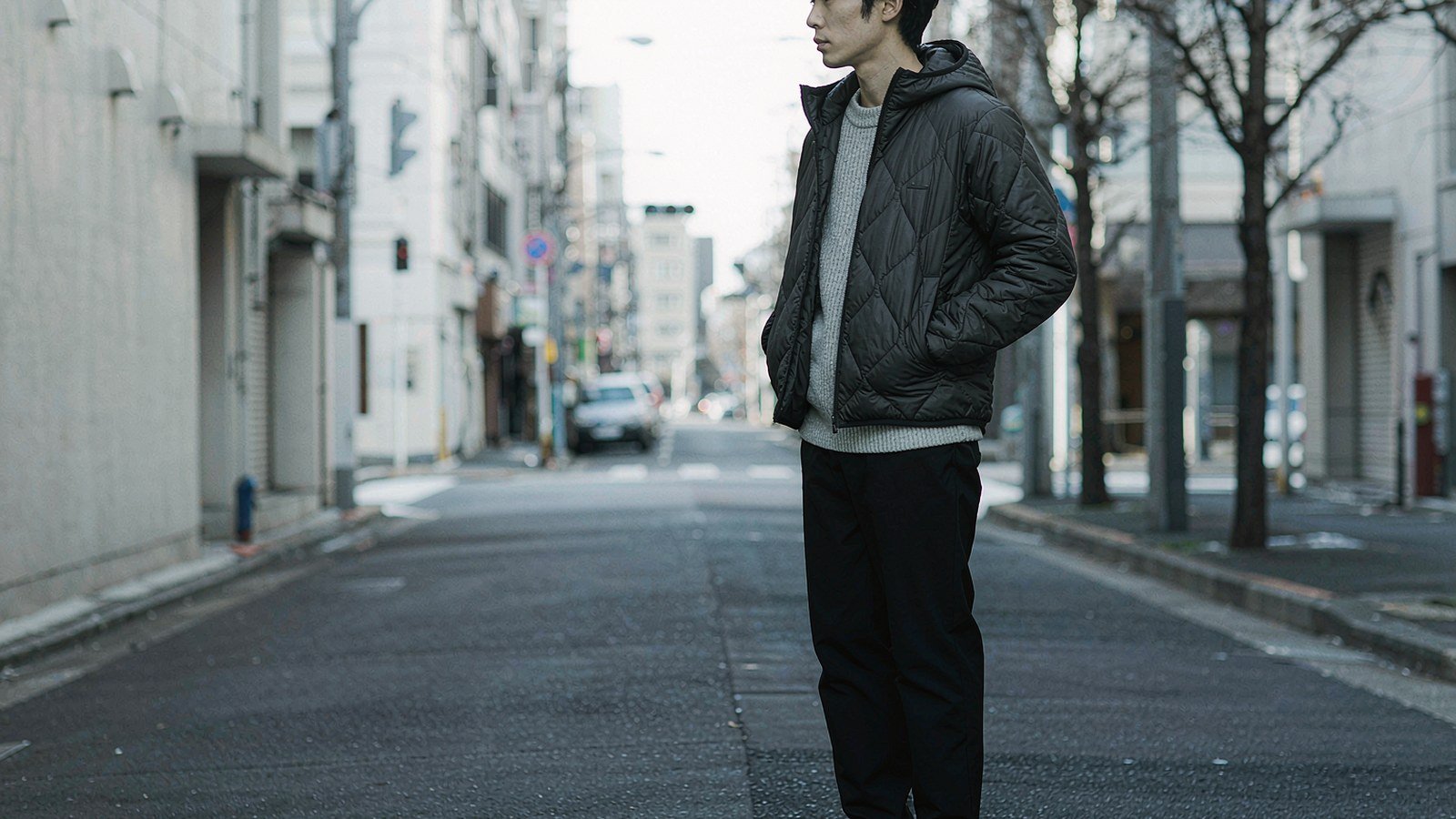
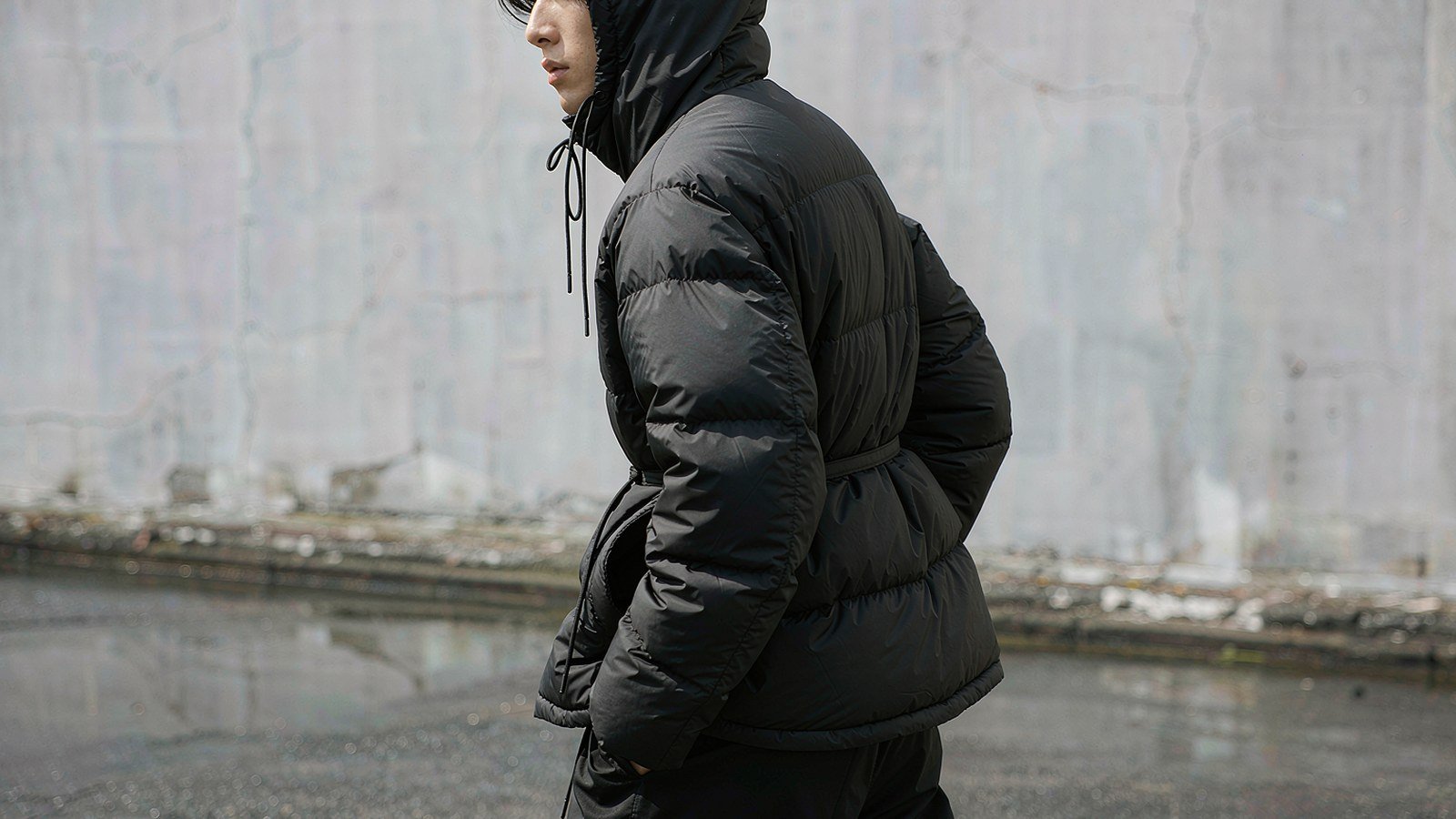
Two down jackets can carry the same 700 fill power tag, the same 200g of down, and still behave like they belong in different climates. The difference is not the down. It is the stitching holding the down in place.
I have pulled apart enough puffers to say this plainly: baffle construction is the single most under-described spec on any product page. Listings will tell you the fill power, the shell fabric, sometimes the fill weight. Almost none tell you whether the jacket is sewn-through or box-wall, and that one detail decides whether you get an even sheet of insulation or a grid of cold lines.
What sewn-through actually means
Sewn-through construction stitches the outer shell directly to the inner lining. The needle goes through both layers, pulling them together along each seam. Down sits in the channels between those seams, and at every stitch line the loft is zero — the two layers are touching.
That matters because down only insulates where it can trap air. Compress it to nothing at a seam and you have created a thermal bridge: a thin line of fabric with no insulation behind it, running the full width of the jacket. On a jacket with seams every 6cm, you are wearing a grid of maybe fifteen to twenty narrow cold strips across the chest and back.
At 5°C you will never notice. At -12°C with wind, those strips read as exactly what they are. This is why a light packable jacket that feels toasty standing in a shop doorway can feel stingy twenty minutes into a walk.
What box-wall changes
Box-wall (box baffle) construction puts a fabric wall between the outer and inner shell, so the two layers never touch. Each chamber becomes a three-dimensional box of its own, and the down lofts to its full height right across the panel — no pinch points, no thermal bridges.
The cost is weight, bulk and money. You are adding internal fabric walls, more stitching, and more down to fill taller chambers. A box-wall parka is heavier and packs down larger than a sewn-through jacket of comparable warmth, and it does not fold into its own pocket.
The payoff is warmth per unit of thickness that sewn-through cannot match. Extreme-cold parkas are box-wall or a variation of it for exactly this reason. When a spec sheet says a parka is rated to -25°C, the construction is doing at least as much work as the fill power number.
The hybrid most jackets actually use
Very few jackets are purely one or the other. The common pattern is box-wall through the torso and sewn-through in the sleeves, or the reverse on lightweight pieces where mobility matters more than the last two degrees.
You can see this on the Canada Goose Hybridge Lite, which is built to be a mid-layer: narrow sewn-through channels throughout, because the whole point is packing small and sitting under a shell. Compare it with the Expedition Parka in the same brand, where the torso is built for -25°C and the baffles are visibly deeper and separated rather than pinched.
How to tell which one you are looking at
You do not need to cut anything open. Three checks, in order of reliability:
- Hold it up to a window. Sewn-through shows a hard line of daylight-thin fabric at every seam. Box-wall shows a shadow gap — you can see there is depth between the layers.
- Pinch a seam between thumb and finger. Sewn-through pinches down to almost nothing, like two sheets of paper. Box-wall has a wall in the middle and resists.
- Look at the channel cross-section at the hem or cuff. If the fabric stands up in a rounded tube, there is a wall. If it lies flat like a quilt, there is not.
One more signal: price and weight relative to claimed warmth. A 250g jacket claiming -20°C comfort is sewn-through and optimistic. A 900g jacket making the same claim is probably honest about the construction.
What this means when you are choosing
Match construction to how you will actually wear the jacket, not to the coldest temperature you can imagine.
Sewn-through is the right answer for city winter at 0 to -8°C, for anything worn under another shell, and for travel where the jacket needs to compress. The Moncler Lans packable is a good example of the type done well: light, thin channels, folds into nothing, correct for a car-to-office winter and wrong for a night on a mountain.
Box-wall earns its weight from about -15°C, in wind, or when you will be standing still rather than moving. If you are buying one jacket for a real winter in a cold city and you hate layering, this is the construction you want.
Hybrid makes sense when you want a jacket that behaves like a parka in the body and like a jacket in the arms — most people, most of the time. The HyBridge Wide Quilt Knit is a hybrid in a different sense: knit panels at the sides give stretch and breathability where a rigid baffle would fight your movement, and the front keeps the down where it counts.
Three things baffle construction does not fix
Worth saying, because construction gets oversold:
It does not fix a bad fit at the shoulders. If the shoulder seam sits past your actual shoulder, cold air enters at the armhole regardless of baffle type. Check the shoulder width before anything else.
It does not fix a weak zipper or a storm flap that does not overlap. A jacket with excellent baffles and a 3mm storm flap leaks at the front centre. That is where you feel winter first.
It does not compensate for the wrong fill weight. Baffle height sets the ceiling; how much down you put in each chamber sets what you actually get. A tall box-wall with half-filled chambers is worse than a well-filled sewn-through jacket.
The check I would do before buying anything
Open the product page, find the highest-resolution photo of the jacket lying flat or worn with arms down, and look at the horizontal lines across the chest. If those lines look like tight quilting — narrow, evenly pinched, fabric pulled together — you are looking at sewn-through. If they look like separate tubes with visible depth, box-wall.
Then ask yourself where the jacket will spend most of its life. Answer that honestly and the construction question answers itself.
If you want to see both types side by side, the puffer jacket collection is sorted by silhouette rather than construction, so it helps to know what you are looking for before you start scrolling. The Maya and the Bady are both sewn-through and both read as city jackets in person; the Mystique Parka is the opposite end of the same scale.